
From the Heights: Kabuya Pamela Bowens-Saffo
Updated: Sep 14
From the Heights marks South Florida native Kabuya Pamela Bowens-Saffo’s first solo art exhibition in Miami. Featuring works from as early as 1977 to present day, this exhibition celebrates the artist’s practice as a printmaker and honors her legacy as a key member of the South Florida art community.
Born and raised in Richmond Heights, Bowens-Saffo was actively involved in the Miami Black Arts Workshop (MBAW) and served as a committed arts educator at the Barnyard Community Center in the historic Coconut Grove neighborhood. This first-of-its-kind exhibition highlights her contributions to Miami’s cultural history, featuring intaglio prints, works on paper, mixed media pieces, and archival materials. It explores the dynamic and evolving visual language that defines her art, which is rooted in personal history and is heavily informed by her experiences of camaraderie, solidarity, and mentorship within artist-led spaces. The title From the Heights reflects the importance of place and people within Bowens-Saffo’s practice, both as an artist and educator.
Currently living and working in Tallahassee, Bowens-Saffo received a Bachelor of Fine Arts degree from Howard University and her MFA from the Tyler School of Art at Temple University. She is the recipient of awards from both the National Endowment for the Arts and the New York Foundation for the Arts.
Early Years: From Richmond Heights to Howard University (1970-1979)
Bowens-Saffo’s artistic journey began in Richmond Heights, a historic South Florida neighborhood established for Black veterans after WWII. She credits much of her creative exploration to her upbringing in this close-knit community. In the 70s (?), while attending Miami Killian Senior High School, she spent her youth exploring Coconut Grove, another renowned Miami neighborhood, where she became involved with the Miami Black Arts Workshop, founded in 1969. On weekends she attended the workshop where she was mentored by its founders Dinizulu Gene Tinnie, Roland Woods, and Robert McKnight. It was here that her passion for printmaking began to take shape.
Her undergraduate studies at Howard University deepened her commitment to creating a visual language grounded in Black culture and identity. She was influenced by visionary artists like Elizabeth Catlett and was taught by Jeff Donaldson, a founder of the AfriCOBRA arts collective. In her early work, Bowens-Saffo began to envision community life and identity, exploring migration as both a transformative process and a symbol of new beginnings. Her etching Under a Perfect Pyramid (1980) introduced the triangle, a symbol of balance that became a recurring motif in her work and persists throughout her printmaking career.
The New York Years: Printmaking and Mythology (1980-1983)
In 1980, Bowens-Saffo moved to New York City to pursue an MFA at Pratt University. While in New York City, she began working at the renowned Robert Blackburn Printmaking Workshop. Under Blackburn’s mentorship and with access to advanced printmaking tools, she experimented with techniques such as engraving, aquatint, and viscosity etching, while developing narratives reminiscent of fables and folklore. The never-before-seen engravings Focus (1981-82) and Emperor Bob Blackburn (1981-82), made during her time at the workshop, exemplify her interest in portraying individuals with mythological proportions – a narrative approach that becomes central to much of her storytelling through printmaking.
At the workshop, Bowens-Saffo printed editions of Hale Woodruff's (1900-1980) woodcuts for the Metropolitan Museum of Art and worked on print projects for prominent artists like Vincent Smith (1929- 2003), Romare Bearden (1911-1988), Thomas McKnight, and Richard Powell. She also taught classes at the workshop and became a master printer, solidifying her expertise in the field.
Return to Miami: Experimentation and Community Engagement (1983-1988)
Bowens-Saffo returned to Miami in the early 1980s, sparking a period of broad artistic experimentation and art production across various spaces in Miami. She nurtured relationships with pioneering local arts figures such as Barbara Young, the art librarian at the Miami Dade Public Library System (MDPLS), and Sylvia Jordan at the Barnyard Arts Center in Coconut Grove, where she worked as an arts educator.
With limited access to printmaking facilities in Miami, Bowens-Saffo turned to other mediums including drawing, watercolor, and mixed media. Her Clock Series (1985/86) epitomizes this shift, marking a period in her life where she juggled multiple jobs while actively building community across South Florida. The visual clocks in this series, rich in figurative elements, symbolize the passage of time and the cyclical nature of life. In one work, the eyes of the figure are depicted as numbers, further reinforcing her narrative style of embedding symbolism into everyday experiences. Her engagement with the vibrant artistic community of Miami is evident in her posters for events like the Goombay Festival in 1986, where she was commissioned to design the poster.
During this time, Bowens-Saffo participated in several exhibitions at the Miami-Dade Public Library System, curated by Barbara Young, and continued to develop her artistic voice. She also served as faculty at the New World School of the Arts and exhibited in a two-person show, Perspectives (1988), alongside renowned artist Camille Billops at the Frances Wolfson Art Gallery, both part of the Miami Dade College system. The archives on view in this exhibition highlight her deep connections to Miami’s art community, featuring materials from key exhibitions, such as Paperwork Six (1989/1990) at the North Miami Center of Contemporary Art, where she collaborated with artists Bob Huff, Carlos Alfonso, and Shelon Lurie.
These early pieces laid the foundation for Bowens-Saffo's evolving visual language, using vivid imagery and recurring motifs to explore the relationship between the individual and the collective, seamlessly flowing between internal and external worlds. The watercolors on view, such as Untitled (1985), highlight joyful scenes of community life, gently contrasting with more contemplative works that depict figures in moments of transition and meditation. Yet, all of these works reflect her broader exploration of human communication, resilience, and self-expression.
Return to New York City: Evolving Visual Language
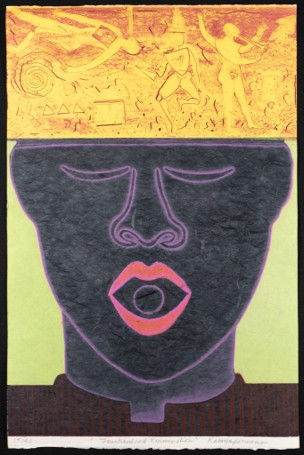
Bowens-Saffo returned to New York City for a brief period, where she worked as an arts educator in the Cooper Union Saturday Program, offering free art classes to NYC high school students. During this time, she produced works as part of a fellowship at the Robert Blackburn Printmaking Workshop. Her etching Fountainhead Rejuvenation (1989), part of a portfolio with other notable printmakers, delves into themes of strength and renewal. A recurring image of an open mouth in the piece symbolizes the challenge of expressing one’s inner world, capturing the tension between inner emotions and outward expression. Reflecting on the piece, she explains, “What motivates you, what builds your identity—how you recognize what’s before you and with you, that prepares you to go forward. It’s that rejuvenation that propels you, that energizes you. You want that history, that family, that past. You want to embrace that.” Her work continually reflects an interest in the intricate relationship between personal history, community, and the internal forces that shape identity.
Recent Works: Legacy & Historical Reflection
In 1998, Bowens-Saffo returned to Florida, where she taught at several local universities including Florida State University and served as a curator at the Anderson Brickler Gallery in Tallahassee. Her recent works continue to celebrate Black life and legacy while engaging with historical themes and social issues, often reflecting figures who have shaped her journey. In Tracks and Bridges (2023), she honors Florida-born sculptor Augusta Savage and civil rights activist James Weldon Johnson, incorporating symbols like the hibiscus flower and the wheel of life to evoke continuity and legacy. In Heart & Soul (2023), a haunting series of etchings, the body becomes a landscape of memory, embodying the "ghosts of colonization." Fragmented scenes and motifs drift around a central figure, encased in a cameo-like shape, alluding to the dominance of power throughout history. A recurring image of a teacup references both historical and ongoing forms of invisible labor, such as tobacco picking and the cultivation of products like coffee and tea, examining the lasting impact of these unseen legacies.
Kabuya Pamela Bowens-Saffo: From the Heights celebrates the rich legacy of an influential artist and also highlights her significant contributions to Miami's art history. Her work shows us the enduring impact of history on contemporary life and underscores the importance of documenting and preserving artists’ archives.
Kabuya Pamela Bowens-Saffo: From the Heights
Dec 2 - March 14, 2025
Miami Dade College, Padron Campus
This exhibition was produced in collaboration with MOAD at Miami Dade College.
Artist Bio
Born in Richmond Heights, Florida, and currently living and working in Tallahassee, Bowens-Saffo received a Bachelor of Fine Arts degree at Howard University and her MFA from the Tyler School of Art at Temple University. She is the recipient of awards from both the National Endowment for the Arts and the New York Foundation for the Arts. Recognized with awards from institutions like the New York Foundation for the Arts and the National Endowment for the Arts, Bowens-Saffo has conducted artist residencies internationally and founded THINKING CAP, a collaborative arts initiative. Her commitment to cultural dialogue and artistic innovation is reflected in numerous exhibitions at venues including the Wallach Art Gallery at Columbia University, Patricia and Phillip Frost Art Museum at Florida International University, Essex Flowers, Oolite Arts, Project Row Houses, and LeMoyne Arts and the French Academy in Rome among others.