
I
N
S
I
D
E
T
H
E
S
T
U
D
I
O
Angela Bolaños
Little Havana, Miami, Florida
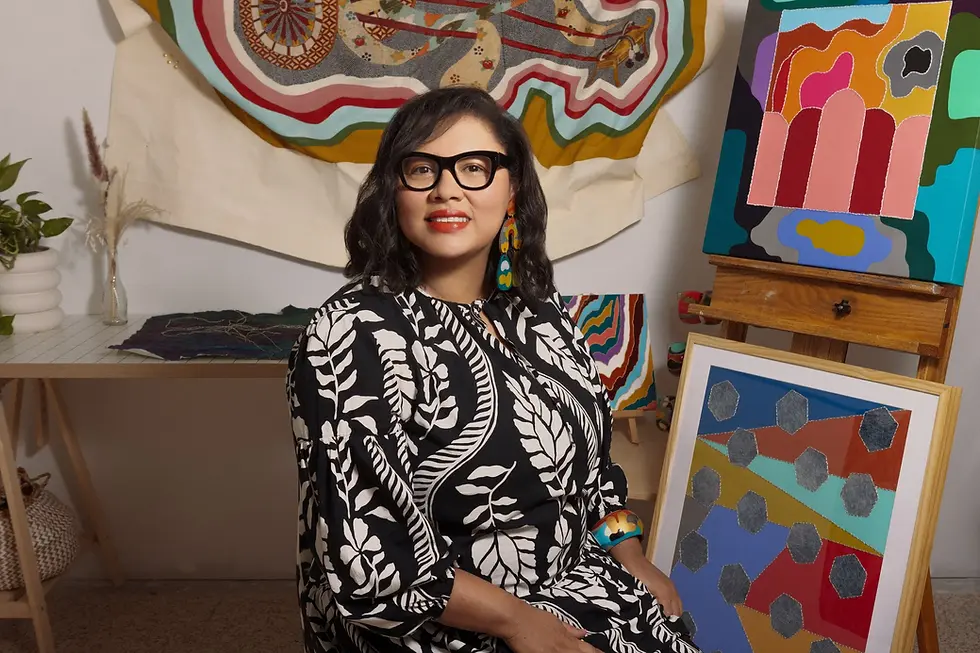
Angela Bolanos is a Honduran American multidisciplinary artist based in Miami. Her practice explores memory, migration, identity, and belonging through painting, embroidery, fiber, installation, and public art. Drawing from personal history, cultural heritage, and the built and natural environments, she create works that investigate how memory is carried through materials, place, and acts of making.
Her work explores the ways memory, cultural heritage, and place shape our understanding of identity and belonging. Drawing from personal experience, ancestral memory, and the emotional resonance of the natural and built environment, I create works that reflect on migration, home, and the stories we carry across generations. Working across painting, embroidery, fiber, installation, murals, and public art, she uses traditional textile techniques and hand stitching as acts of drawing, repair, and remembrance. Through layered surfaces, repeated gestures, and tactile materials, she explores what we inherit, what we preserve, and how memory continues to shape our lives.
Each work becomes a space where memory is held, transformed, and carried forward—an invitation to reflect on the connections between past and present, personal and collective, and the enduring search for belonging.
INTERVIEW
Place | How does place shape your practice, and what does this studio or the place where you work mean to you?
AB: Place has always been central to my practice, perhaps because I have spent much of my life navigating the distance between where I come from and where I am. Growing up in Honduras and building a life in the United States have shaped the way I understand home, memory, and belonging. I'm interested in how we carry places with us, how they change in our memories, and how we reconstruct them through the things we make.
Miami has become an important part of that experience. It is a city shaped by migration, where different cultures, languages, and personal histories coexist. There is something familiar about that constant movement between places and identities.
My studio at Tower Artist Studios Miami, in Little Havana, is much more than a place where I produce work. As one of its founding artists, I have been part of building a creative community where artists share space, ideas, resources, and everyday experiences. That sense of community is especially meaningful to me. Artmaking can be a solitary practice, but it doesn't have to happen in isolation.
The studio is where different parts of my life come together. It holds my materials, unfinished ideas, experiments, and the ordinary routines that sustain a creative practice. In many ways, it has become another version of home, one that continues to evolve alongside me.
Process | Can you tell us about your process and what happens in the studio that we might not see in the finished work?
AB: My process is rarely linear. I often begin with an image, a memory, a material, or something seemingly ordinary that stays with me. It might be a chair, a leaf, a vessel, or a fragment of fabric. These objects and forms become starting points for exploring larger questions about memories and how they are so deeply connected to family, time, culture, the built environment and nature. I work across painting, embroidery, textiles, and sculpture, and I enjoy allowing these different approaches to inform one another. A textile work becomes a painting, or a small experiment develops into an installation. I don't always know where something is going when I begin, and I've learned to value that uncertainty.
What people don't necessarily see in the finished work is the amount of time spent looking, reconsidering, undoing, and beginning again. There is a great deal of repetition in my practice, particularly when working with thread and fiber. These gestures require patience, but they also create space for reflection. I'm interested in how communities value physical labor and labor intensive process, how these become signifiers of care and attention, an expression of love.
There is also a playful side to my process. I like experimenting with materials, bringing together things that don't necessarily belong together, and discovering unexpected possibilities. Not everything works, of course, but those moments of failure are often where something interesting begins. I think of the studio as a place of continuous discovery. The finished artwork is only one part of a much longer conversation between memory, material, intuition, and making.
Preservation | What would you want people to know or remember about your practice that may not be visible in the work itself?
AB: I would want people to understand that, at its core, my practice is about the human experience and our efforts to make sense of it. Although my work often draws from personal memories, family relationships, and my Honduran heritage, I don't see these experiences as belonging exclusively to me. They are starting points for conversations about things we all encounter in different ways, such as love, separation, change, loss, and the desire to belong. I'm particularly interested in the knowledge we inherit through ordinary gestures, objects, and traditions. The things that are passed down without necessarily being written or formally recorded. A familiar object, a repeated gesture, or a material associated with domestic life can hold an extraordinary amount of meaning. Much of my work is an attempt to recognize and give space to those forms of knowledge.
I would also want people to remember the importance of care in my practice. Care for materials, for the people and memories that inform the work, and for the time it takes to make something by hand. In a world that often values speed and immediate results, I find meaning in processes that ask us to slow down and pay attention.
Ultimately, I don't think of preservation as simply holding on to the past. I'm interested in how we carry it forward, how we reinterpret what we've inherited, and how making can become a way of remembering while also imagining something new. If there is one thing I hope remains, it is the understanding that even the most ordinary parts of our lives are worthy of attention, and that art can help us recognize their significance.
Artworks


